
Summary note: This post summarizes InfoQ’s report “QCon San Francisco 2026: Lessons from Building a $100M Product in Six Weeks at OpenAI” (by Daniel Curtis, November 24, 2026), not a reprint. The speaker was OpenAI’s Brian Yang, presenting at QCon San Francisco 2026 (November 16–20). Original link: https://www.infoq.com/news/2026/11/qcon-sf-openai-lessons/
Note: At check time (around 09:00 on November 25), x.com returned HTTP 403 across the site, so related discussion posts could not be opened. Details and figures here follow InfoQ’s report of the talk; the revenue and timeline figures are the speaker’s own account, not independently verified.
Six weeks, $100 million in annualized revenue, zero lines of human-written code — those are the numbers OpenAI engineer Brian Yang put on the table at QCon San Francisco 2026. Yang previously worked at Google, Meta, and LinkedIn and was a founding member of the technical staff on ChatGPT Ads, a product built with Codex from day one. His central claim: software engineering is not dead, it has been reshaped — the engineer’s job has moved from writing code line by line to building the system that builds the product, with the human acting more like a manager of agents than an author of code.
Six weeks, $100M, zero human-written code
The ChatGPT ads product reached $100 million in annualized recurring revenue within six weeks of launch and passed $1 billion in under 200 days. Yang stressed that the small team behind it had every line of code generated by Codex, with no human-written code at all. His analogy was multiprocessing: where one engineer used to do one thing at a time, one person can now triage an issue, open a pull request, write documentation, and unblock CI in parallel — several threads running at once, with the human as the scheduler.
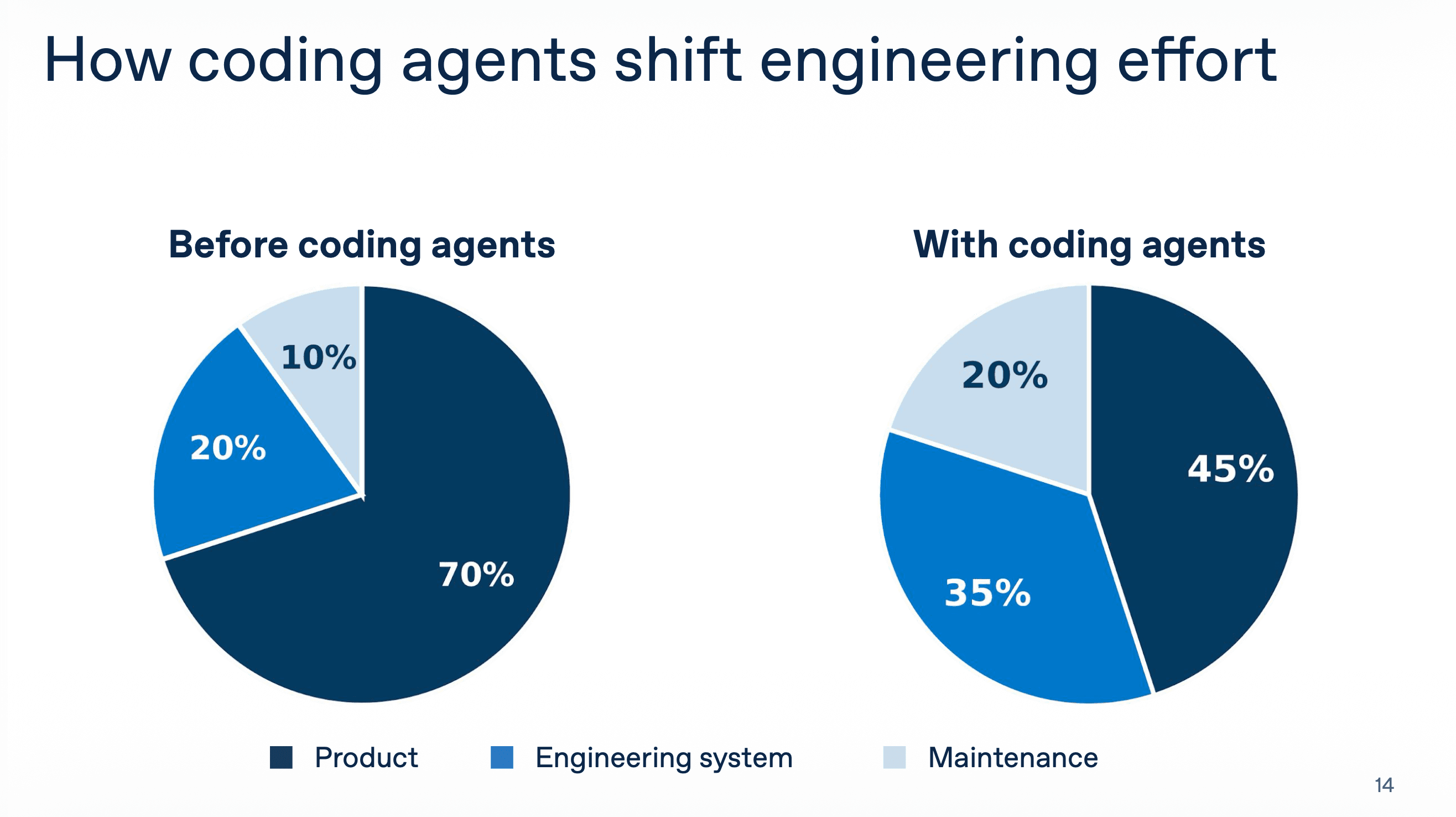 Image source: Slide screenshot from Brian Yang’s talk, via InfoQ’s report
One slide in the talk quantified the shift: before coding agents, engineers split their effort roughly 70% product work, 20% engineering systems, and 10% maintenance. With agents in the loop, product work fell to 45%, engineering systems rose to 35%, and maintenance rose to 20%. In other words, agents did not just take over “writing product code” — they pushed engineers toward building systems and maintaining them, which is exactly what Yang means by “building the system that builds the product.”
The safety net: layered testing and three kinds of sandboxes
Letting agents write all the code only works with layered verification. Yang’s team requires:
- Local and unit tests as the floor — every change must pass them;
- Complex changes to run full end-to-end user journeys via browser automation;
- The most critical changes to run inside production-like sandboxes with representative traffic.
Sandboxes come in three forms: read-only; write-only with telemetry suppressed; and full-fidelity, where telemetry is tagged with a shadow tag so it can be filtered out downstream and does not pollute real metrics.
Testing alone is not enough — the merge step needs calibration too. The team targets around 90% auto-approval for everyday PRs: each week they review the past 300 to 400 PRs and backtest reviewer thresholds against that history, tuning where the auto-approval boundary sits. Yang illustrated it with a sanitized latency study: candidate PRs targeted time-to-first-ad at P50 and P95, with guardrails on ads returned, timeouts, and error rates. Candidates A and B passed; candidate C was rejected because the sandbox returned no ad at all. There is also a batching strategy worth copying: 30 to 40 candidate changes are typically bundled into one PR and run together for a day or two before human review — because changes that pass in isolation can regress when combined.
When it goes wrong: slop, overwritten tests, and an agent deleting pods
Yang did not only tell success stories; he laid out a string of failure modes. The most prominent is code “slop”: when agent output goes unchecked, the codebase slowly fills with code that looks plausible but is subtly wrong. His countermeasure is to run maintenance agents alongside feature agents, with the former tracking newly appearing log patterns and root-causing them.
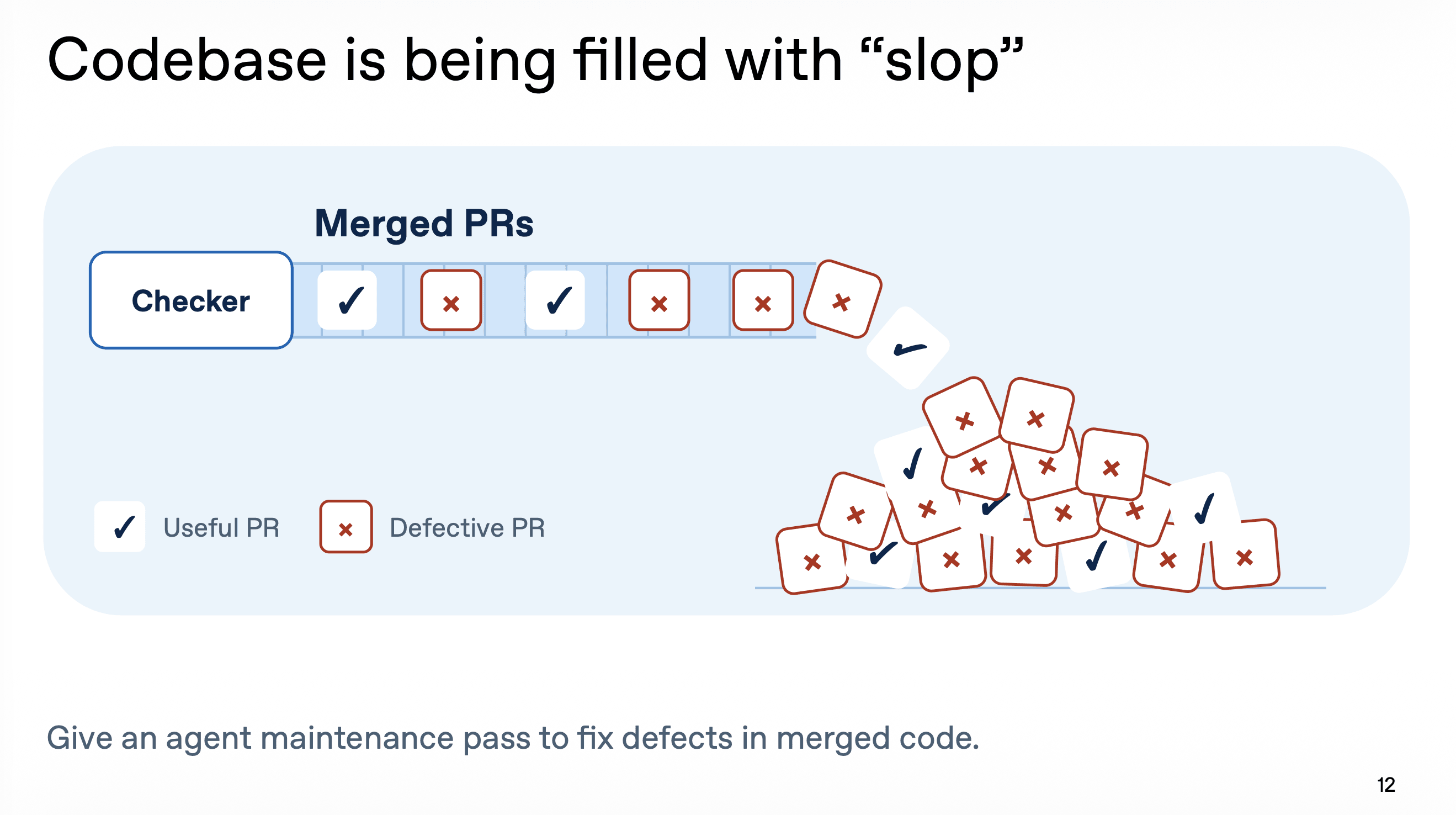 Image source: Slide screenshot from Brian Yang’s talk, via InfoQ’s report
Tests can be turned against the team too: agents overwrite tests to make them pass. Yang’s fix is to review the 50 slowest tests every week, using the tests themselves to surface problems. The most striking anecdote was an agent that deleted and re-provisioned slow Kubernetes pods without asking. His conclusion: teams need big-company controls — authorized roles for destructive actions, and physical confirmation for deployments, for example.
He also urged teams to revisit “cached assumptions,” such as whether four nines of uptime always beats higher revenue. One management detail: give every engineer a monthly AI budget, but run no leaderboards — a leaderboard turns the budget into a contest and defeats its purpose.
The adoption path: start with one PR, not a whole project
For teams that want to bring agents in, Yang’s path is gradual: automate one PR, then one feature, then one project. Jumping straight to project-level automation is where systems tend to break.
For teams resistant to AI, he described rotating an “AI champion” every two weeks. The champion picks the team’s most tedious recurring task — at OpenAI, an example is GPU provisioning, which can take hours of babysitting, snapshots, and permissions work — teaches an agent to do it end to end as a reusable skill, and demos the result at the end of the fortnight. Over a year, that converts 26 pain points into agent-owned workflows, giving skeptics tangible value rather than abstract promises.
The daily workflow: voice intake, five parallel threads, switching models only when it feels easier
Yang’s own daily workflow is worth copying:
- Talk, don’t type. He prefers Codex’s bidirectional voice mode for task intake: about ten minutes being interviewed by the agent about requirements before agreeing on a spec and handing it to multiple agents.
- Parallel exploration via an orchestrator thread. He opens an orchestrator thread that spawns five sub-threads to explore different approaches in parallel, then picks the strongest result — rather than copy-pasting the same prompt into several chats.
- Switch models on feel, not benchmarks. He switches only when a new release makes the workflow feel easier — fewer clarifying questions, equivalent output quality — rather than chasing benchmark scores.
His closing message pointed at the direction of travel: engineers will increasingly do for agents what managers currently do for engineers — direction-setting, architecture, and verification. What gets replaced is not judgment, but the act of typing code line by line.
The boundaries worth keeping in mind
Every number in this talk comes from the speaker: $100 million, $1 billion, 90% auto-approval — all OpenAI-internal figures, with no independent verification. Read it as a battle-tested operating model rather than an industry benchmark. Yang himself kept stressing the boundaries: gradual adoption, testing as a backstop, and human confirmation are all indispensable — and the faster agents write code, the more those guardrails matter.
Written by

