
Summary note: This is a summary of Architect Labs’ official blog post “Introducing Frostbite: A new CPU architecture discovered, designed, and verified end-to-end by AI” from November 18, 2026, and an X post by @architectlabs from the same day — not a reprint of the originals. Original links: https://architectlabs.com/blog/frostbite , https://x.com/architectlabs/status/2123187520276152487
Note: At the time of checking (November 21, ~09:05), x.com returned HTTP 403 across the site, so @architectlabs’ original post could not be opened; its timestamp (5:52 p.m. ET, November 18) and engagement figures (3,075 likes, 104 replies and quotes), plus the Hacker News figures (602 points, 316 comments), come from AI Lately’s tally of public data and could not be verified directly. All figures and details here follow Architect Labs’ official blog post; all performance numbers are simulations, and the chip has not been taped out.
A week after OpenAI used GPT-6.2 Astra to optimize AMD GPU IP, the AI-designs-chips story has taken another big step: on November 18, Architect Labs introduced Frostbite, a general-purpose CPU — not an optimization of an existing design, but a brand-new instruction-set architecture discovered, designed and verified to final GDS (the layout sent to manufacturing) by AI agent swarms, starting from interaction-net theory alone.
Starting from interaction nets: why efficiency can be so much higher
Frostbite’s design starts from interaction nets, a model of computation proposed 35 years ago by Yves Lafont. Its core properties are three: every computation step is local, touching only a small part of the graph; every value has exactly one owner, so there is no shared mutable state; and rewrites of connected node pairs never overlap, so they can run in any order — or all at once — with the same result.
That means two things for hardware. First, parallelism comes for free: dependencies are never thrown away, so there are no threads, locks or race conditions, and none of the out-of-order machinery a conventional core uses to rediscover parallelism at runtime. Second, data can live in small local memories next to where it is used, saving the area and power a conventional chip spends on deep cache hierarchies and coherence protocols.
Programs are written in Vine (a full language with Rust-like syntax) and compiled to Ivy, an intermediate representation encoding the interaction-net structure. The optimizer then applies as many graph-reduction rules as it can. Runtime parallelism is not encoded in the structure but derived from state at runtime and pipelined spatially.
The process: how agent swarms went from zero to GDS
Frostbite was designed with zero architectural priors, with multiple agent swarms following this process:
- Architecture exploration and selection. The team first defined five workload categories by how a program exposes its work (many independent pieces at once, rounds of parallel work, long sequential chains, data-dependent branches, recursion), each split into a search set and a held-out eval set. Agent swarms synthesized research papers and benchmarks and built Python models to trade off high-level architectural ideas, producing a 141-page PDF as the starting point (deleted after the first architectural iteration, since many of its numbers and estimates were far from what was physically possible).
- Formal contracts and system modeling. The team designed an in-house specification language, ASL, and wrote Frostbite’s system model, “Arcmodel,” in it. ASL supports machine-checkable translations and refinements, with power and performance estimates accurate to within 1–5%, running roughly 200× faster than RTL simulation and formally verifiable through “contracts.” ASL also translates natively to Lean, used for all theorem proving.
- RTL and alignment. Arcmodel was initially not physically aware, and its power and performance estimates diverged from timing-converged, synthesis-clean RTL by almost 250% in the worst case. A fully autonomous pipeline first located power hotspots in the RTL, traced them to key counters in the formal specification, and let the model write arbitrary scalar Python functions over those counters to predict power, repeating until RTL and Arcmodel agreed to within 5%. After that, full Arcmodel chip simulations ran 660× faster than RTL.
- Contracts, Arcmodel, RTL and power iterated together. From then on the ASL contracts were the only specification: swarms proposed architecture revisions in parallel worktrees, each change checked against the contracts, modeled in Arcmodel, implemented in RTL and measured for power, then kept or dropped. Across four searches and a final round of ablations, the swarm tried 58 ideas and kept 37 — from clock gates on a running tile to smaller L3 tables and one shared expander.
Throughout, the AI iterated tightly over Frostbite’s ISA, Arcmodel, design and verification, with the ASL contract as the single provable source of truth. In the end, Frostbite’s ASL lowered to more than 800,000 lines of Lean, covering contracts for all 31 blocks.
An emergent property: work-stealing nobody taught it
The most striking part is not any single number but a behavior the agents “discovered” themselves. Because parallelism spreads over space, there is no central scheduler; the agents designed three elegant rules for a tile: run its own work first (work in its input ports); if those are empty, take work from a neighboring tile that has work to spare; if no such tile is found, go inactive and save power.
In hardware terms, the compiler breaks code into short sections (frames) that run uninterrupted once their inputs are ready; when a loop or branch splits into parallel pieces of unknown size, the running section parks what comes after into a small record in local memory (the frame manager), drops the new tasks onto a hardware queue (the work queue), and picks up the newest one itself; idle neighbors pull the remaining tasks over the network; as tasks finish anywhere on the chip in any order, their return packets tick down the parked record’s counter and automatically wake the next section the instant the last piece arrives.
The blog stresses that this behavior was never specified by any human and can be traced directly back to necessity on specific regressions and hill-climbing performance metrics.
Results: 4.59× perf-per-watt, 3.83× on the held-out set
Frostbite was synthesized on a 7 nm process, reaching 800 MHz timing at synthesis and 500 MHz in the final GDS. One Frostbite quad (a two-by-two grid of tiles) paired with four L3 nodes is 0.792 mm²; the comparison target is a single core of a modern superscalar (dual-issue, in-order) CPU, called TCPU, at 0.895 mm² on the same process.
The evaluation covers 25 workloads: dense parallel kernels such as gemm and conv2d, plus irregular branching programs such as JSON parsing, Huffman coding, k-d trees and recursive Fibonacci; 10 drove all architectural optimization (search set) and 15 were held out (including five practical workloads added later: a Kalman filter, PCA, finite element analysis, an LU solve and LZ4 decompression).
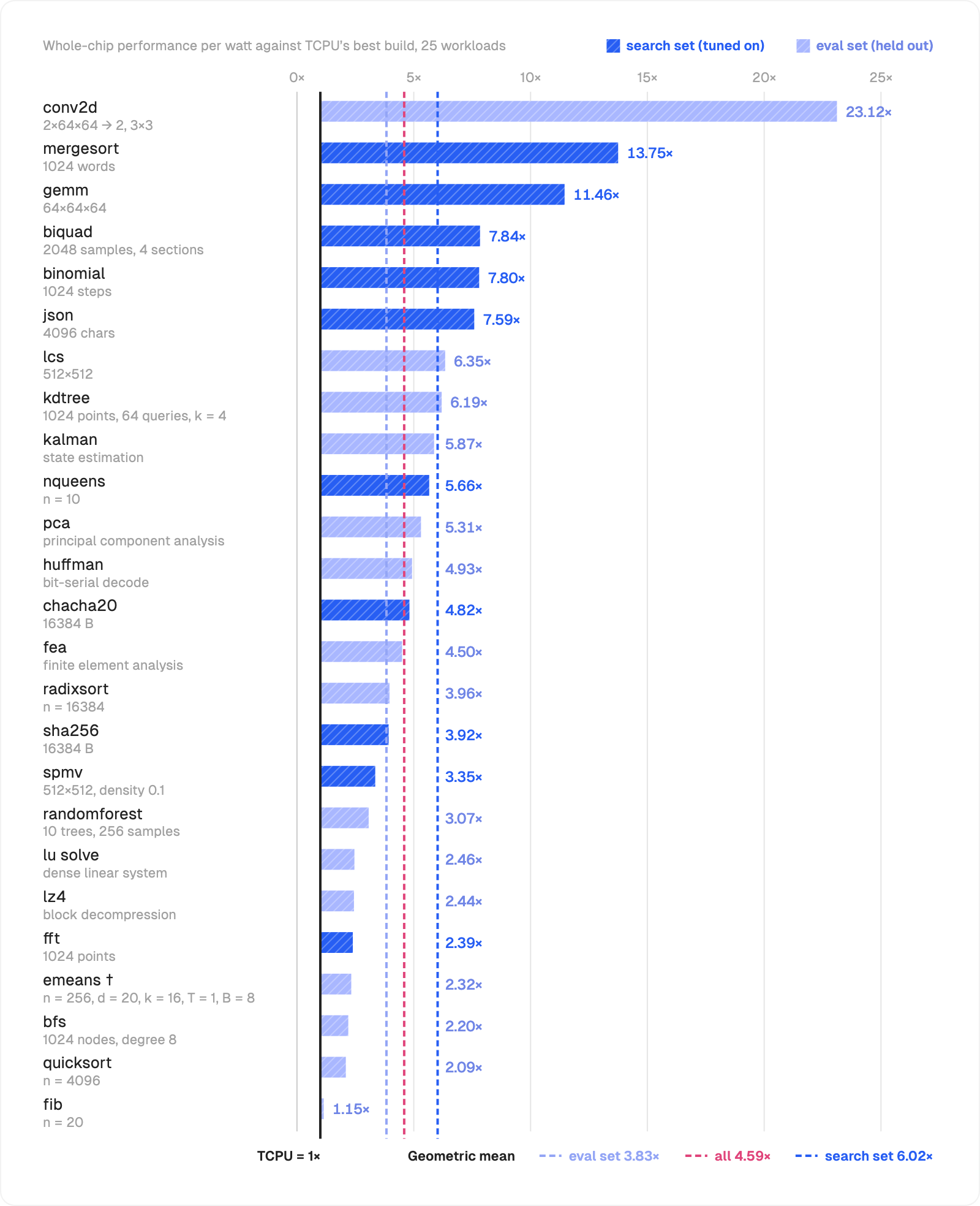 Image source: Architect Labs, original post
- Geometric-mean performance-per-watt of 4.59× versus the TCPU: 6.02× on the 10 search-set workloads, and 3.83× on the 15 held-out workloads it was never tuned on.
- Average performance-per-area of 8.77×. The best single workload was conv2d in the eval set (23.12×); the lowest was fib in the eval set (1.15×).
- The energy breakdown shows where the savings come from. Excluding clock distribution (49% of TCPU energy, 41% of a Frostbite quad’s): the TCPU spends 57% of its energy on memory and 27% on fetching, decoding and issuing instructions; Frostbite cuts memory to 38% and fetch/decode/issue to just 6%, paying 26% for its on-chip network and scheduler. Scaling to a four-by-four array (four quads) leaves the power distribution roughly the same — while scaling a conventional multi-core CPU requires adding heavy coherency mechanisms and large caches.
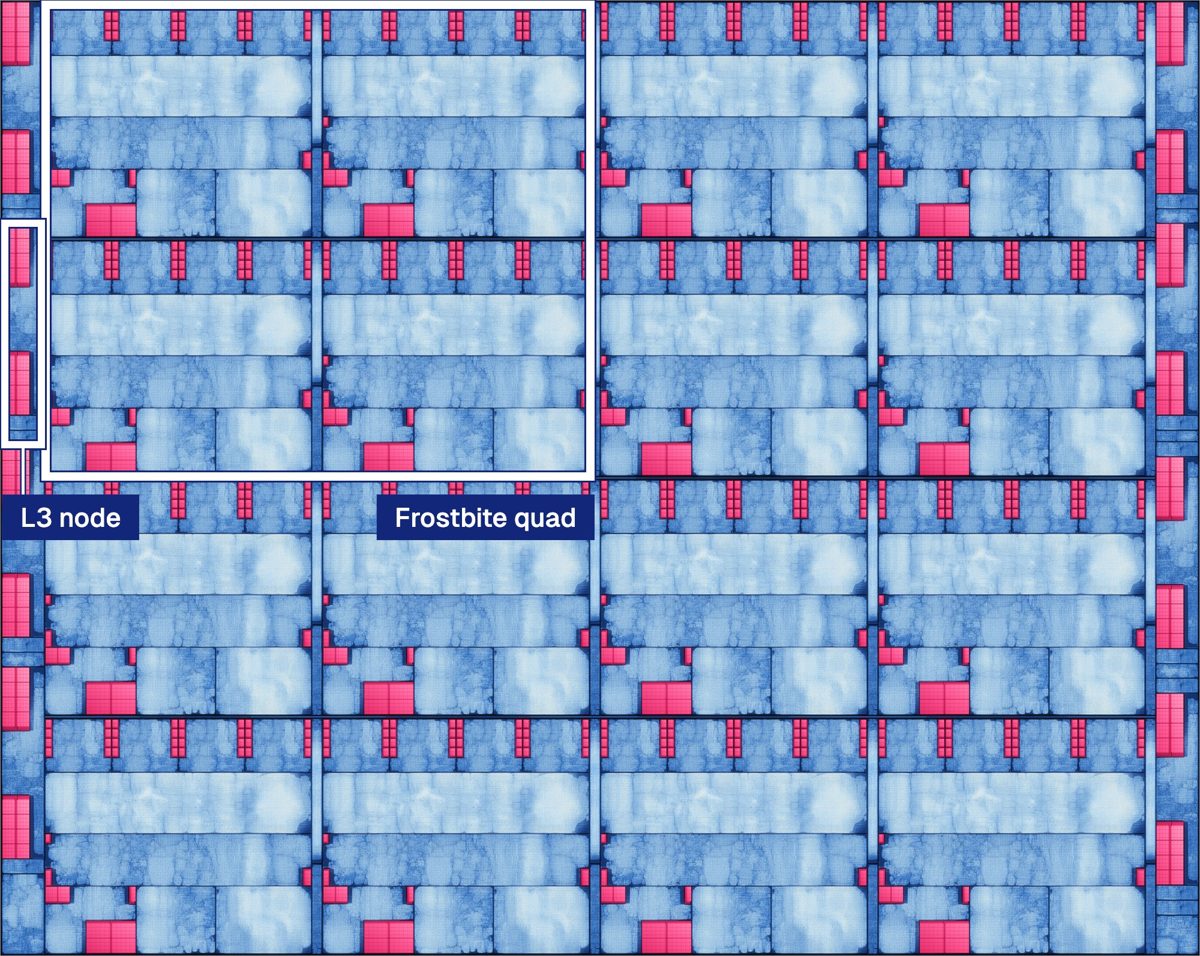 Image source: Architect Labs, original post
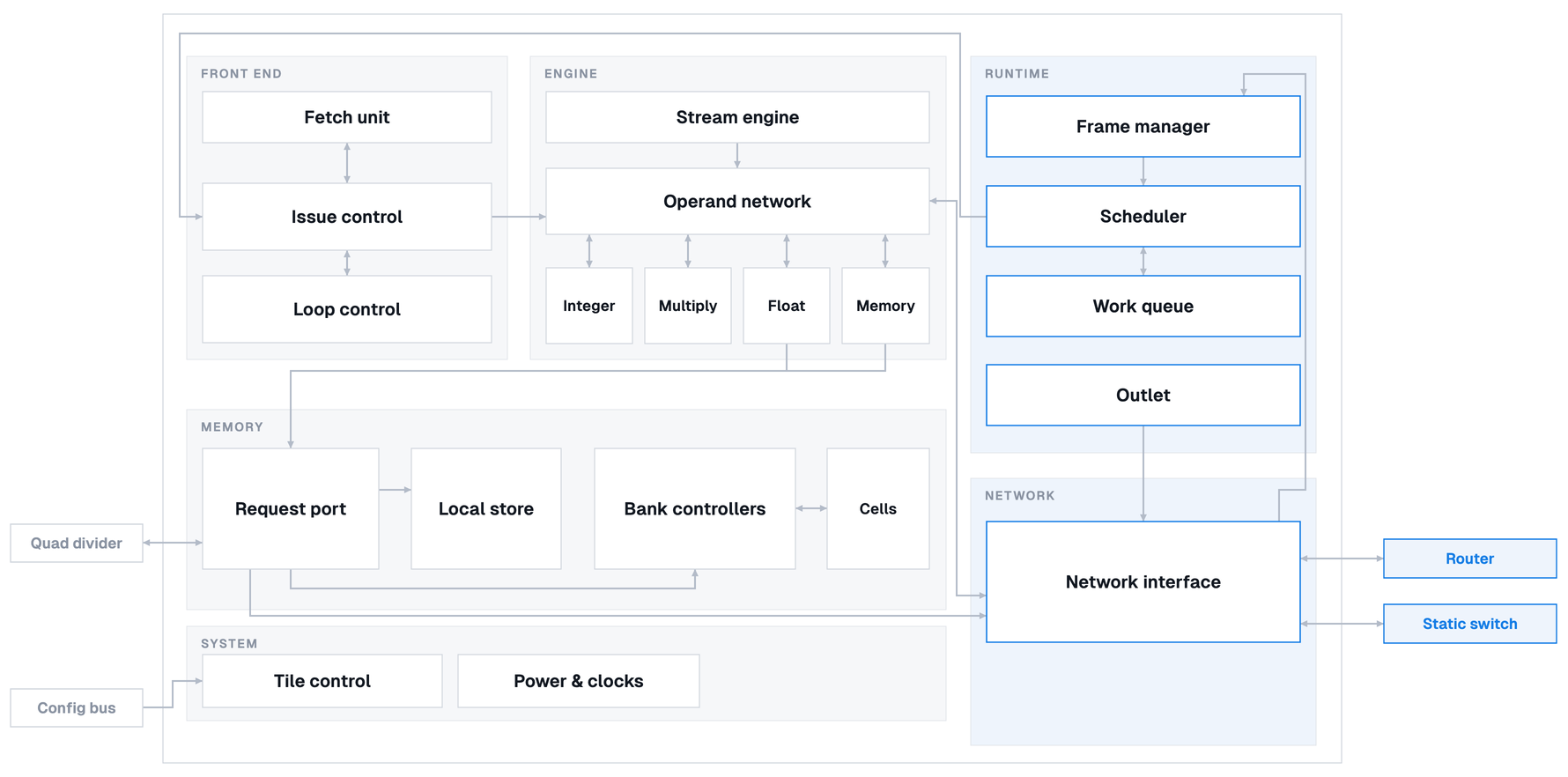 Image source: Architect Labs, original post
Limitations, criticism, and what’s next
Three points need to be stated plainly:
- All numbers are simulations; the chip has not been taped out. Power figures are estimates from post-synthesis RTL, and the blog itself notes that “over multiple tapeout loops, ASL models can be correlated to true post-silicon, production power numbers” — in other words, real silicon data does not exist yet.
- The comparison target is relatively modest. The TCPU is a dual-issue in-order core, not a wide out-of-order high-performance core; the blog does not disclose the exact CPU “for legal reasons.” The 4.59× figure is relative to that baseline and cannot be extrapolated directly to top out-of-order cores.
- A credit dispute. Per AI Lately, a critic said young engineers at Architect Labs leaned on outside research and left out proper credit; as of publication, the company has not answered that claim directly.
Architect Labs’ next steps include hosting a software playground for anybody to run a program on Frostbite on FPGAs; building a preliminary operating system for managing hardware resources, multiple programs and virtualization; scaling the swarms further and benchmarking on a much larger set of industry benchmarks such as SPEC and PARSEC against a broader set of CPUs; and releasing Frostbite’s RTL and ISA.
Whatever fraction of the numbers survives contact with real silicon, Frostbite marks a shift: AI systems are no longer just implementing architectures humans specified, but doing extreme co-design across workloads, ISA and hardware, discovering design space human architects struggle to reach. As the blog puts it, with large agent swarms, sophisticated search techniques, precise guardrails, formal verification and faster EDA tools, AI systems will be able to discover and build novel accelerators “at a quality that exceeds human cognition.”
Written by

