
Summary note: This post summarizes Anthropic’s official article “MCP servers can now ship skills, run tasks, and more with Claude” (November 24, 2026), not a reprint. Original link: https://claude.com/resources/articles/skills-over-mcp-tasks-and-more
Note: At check time (around 09:00 on November 26), x.com returned HTTP 403 across the site, so related discussion posts could not be opened. Details, statuses, and figures here follow Anthropic’s official article.
Two years ago, Anthropic launched the Model Context Protocol (MCP) as a new standard for connecting AI agents to the systems where data lives. On November 24, it marked the anniversary with four updates: Skills over MCP enters public beta, Tasks and Elicitation are generally available, and File Uploads is rolling out soon.
Anthropic’s one-line summary: with these updates, Claude can work with a server more like it works with another agent — learning from it, delegating to it, and exchanging input and files along the way.
Ship expertise alongside tools with Skills over MCP
Tool names and descriptions tell Claude what a server can do, but they do not cover how to handle specific use cases. With Skills over MCP, servers can publish skills alongside their tools to help Claude take on longer, multi-step work. Claude loads a skill only when it is needed, keeping context use low. Skills update with the server, so developers can ship tools and guidance together and users have nothing separate to install.
Skills can cover best practices, step-by-step workflows, or even playbooks tailored to a user’s account or organization. The official examples:
- Shopify helps Claude design and update a merchant’s online store end to end.
- HubSpot onboards customers and gets them set up in Claude.
- Atlassian helps Claude draw on deep organizational context for insights and work analysis.
- Carta will help Claude draft and issue equity from an uploaded document (coming soon).
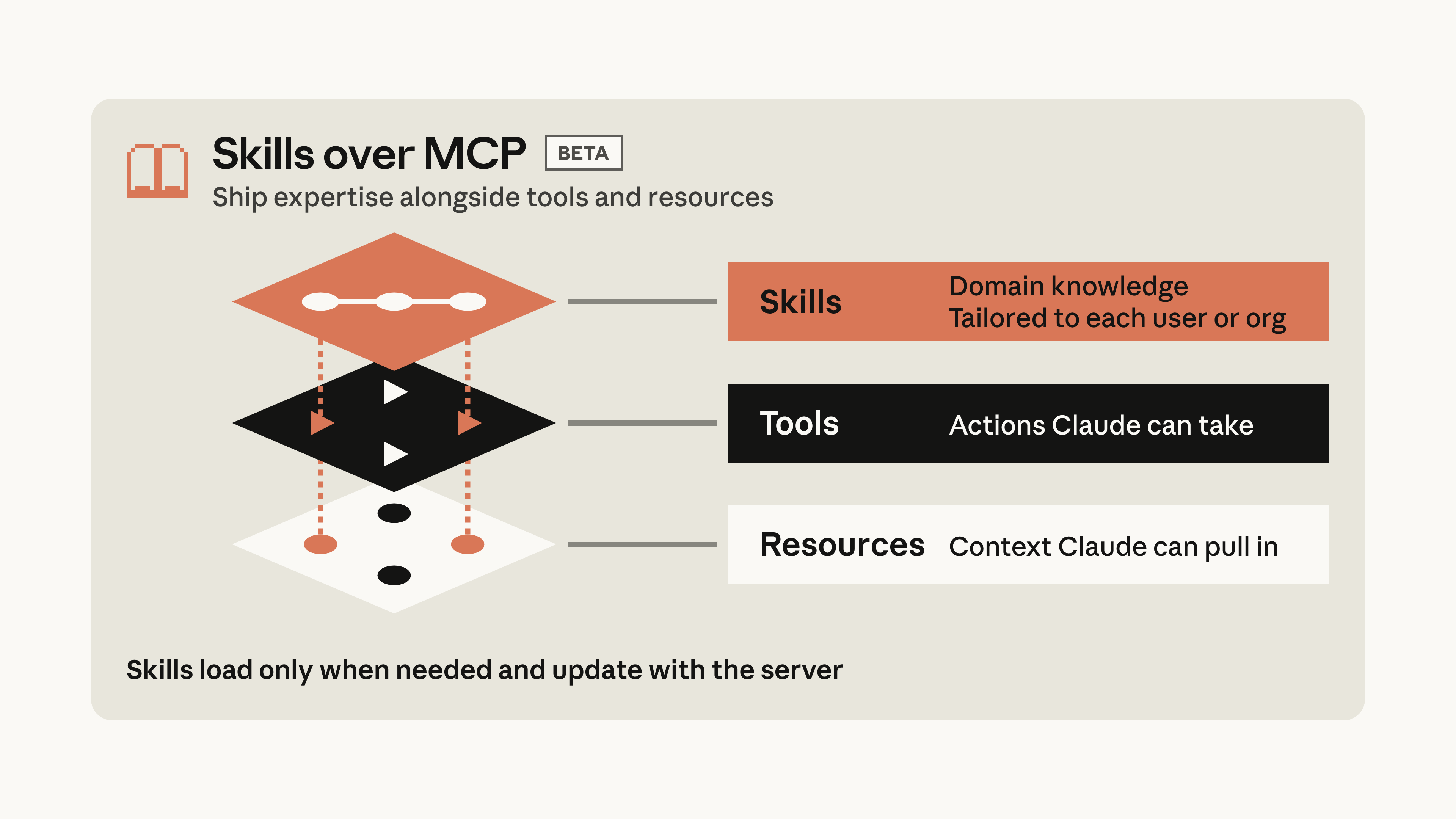 Image source: Illustration from Anthropic’s official article
Status and availability: Skills over MCP is in public beta in Claude and Claude Code, on by default for Pro, Max, and Ultra plans and available to Team plans once an admin enables it. Coming soon to Enterprise.
Hand off long-running work with Tasks
Tool calls used to have to finish before Claude could move on. With Tasks, servers can run operations that take time, or even full agent loops, while Claude keeps working and picks up the result when it is ready. Using Tasks, ZoomInfo runs deeper accounts and contact research that previously took several prompts.
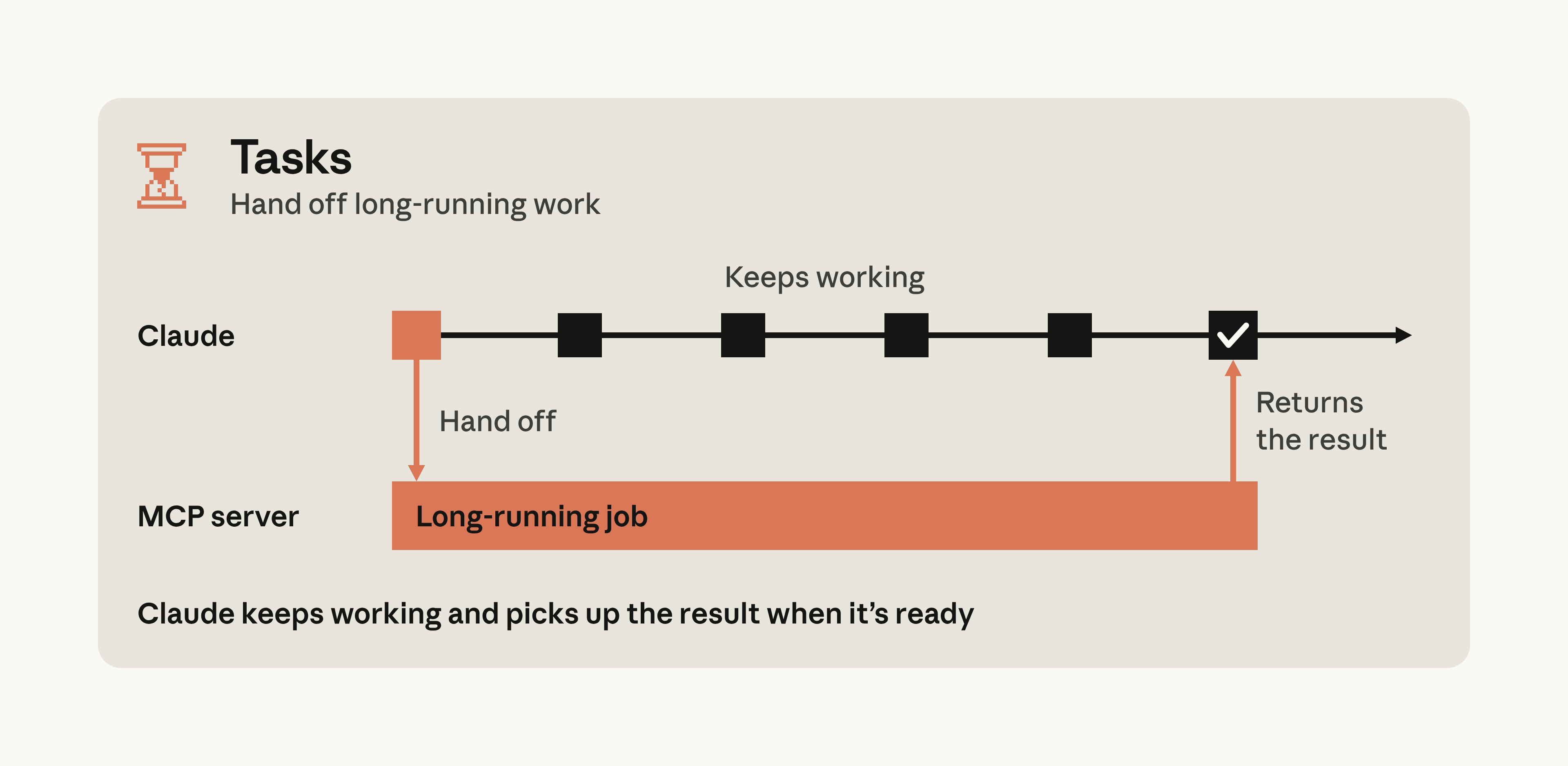 Image source: Illustration from Anthropic’s official article
Ask for input mid-call with Elicitation
Some actions need a user’s sign-off, like spending money or deleting data. With Elicitation, a server can pause to ask the user for input through a form or link, then continue where it left off. The official examples:
- Supabase confirms costs before creating a paid project and before running destructive SQL.
- Railway asks before making potentially destructive changes, like removing a service.
- GitHub has users enter a repository’s name before an agent deletes it.
Tasks and Elicitation are now generally available in Claude and Claude Code for Pro, Max, and Ultra plans, and rolling out to Team and Enterprise organizations.
Send and receive files with File Uploads
File Uploads is rolling out soon: Claude will be able to pass files to MCP servers, not just text. The File Uploads extension sends PDFs, spreadsheets, and images to a server without passing them through the context window. It is rolling out in Claude and Claude Code to Pro, Max, Ultra, and eligible Team and Enterprise plans.
Built on stronger foundations
These features are part of the open MCP spec and its extensions, so a server that supports them works in any compatible client, not just Claude. To add support, see the docs for Skills over MCP, Tasks, Elicitation, and File Uploads.
Anthropic also summarized four ways MCP in Claude improved over the past year:
- More token efficient: Tool search loads tool definitions only when needed, which can cut the context they use by over 85% in multi-server setups.
- Easier to scale: The latest MCP spec is stateless and supported across Claude products, making it easier to build servers and maintain their reliability as they grow.
- Simpler to authorize: The Enterprise Managed Auth extension lets admins authorize supported servers once, so users connect automatically.
- More interactive: The MCP Apps extension brings full interfaces into Claude, beside the conversation or full screen.
The scale numbers: MCP now sees over 700 million monthly SDK downloads, and there are over 10,000 MCP connectors for Claude. MCP is an open standard, hosted by the Agentic AI Foundation and shaped by the people who build on it.
Same-week update: Claude Code 2.1.332
Anthropic released Claude Code 2.1.332 on November 25, bringing MCP-served skills into the terminal: skills from MCP servers show as server:skill in the / menu, while other skills keep their names. The release also fixes a long list of hangs and freezes and adapts Sonnet for users on Foundry or Google Cloud (per the release notes).
Taken together, the direction of these four updates is clear: a server is no longer just a bundle of tool endpoints. It now carries knowledge (Skills), takes on delegated long-running work (Tasks), and negotiates human sign-off at the consequential moments (Elicitation). For anyone building automation on MCP, durable task handles and standardized approvals turn long-running, human-supervised agent work from an app-level workaround into a feature of the protocol itself.
Written by

