Summary note: This is a summary of Contra Labs’ official blog post “Frontier Design Benchmark: Evaluating AI Design” from November 18, 2026, and an X post by Contra founder Ben (@contraben) from the same day — not a reprint of the originals. Original links: https://contralabs.com/research/frontier-design-benchmark , https://x.com/contraben/status/2123150473465401719
Note: At the time of checking (November 22, ~09:05), x.com returned HTTP 403 across the site, so @contraben’s original post could not be opened; its engagement figures (2,696 likes, 1,436 replies as of 23:10 UTC, November 21) come from AI Lately’s tally of public data, and the roughly 400,000 views from Top5Apps’ check on November 19 — neither could be verified directly. All figures and details here follow Contra Labs’ official blog post; Gestalt’s maker is undisclosed, and leaderboard numbers keep moving as votes come in.
Design benchmarks have long had the same flaw: toy prompts like “build a landing page for a coffee shop,” judged by whoever happened to show up, with a score that says who won but never how to improve. Contra Labs’ new benchmark tries to fix both — tasks drawn from real paying clients’ briefs, judged by working professionals. And on its first day it produced a big story: a mystery model nobody can name, Gestalt, scored above every public model, and above the human designers’ golden reference designs.
How the benchmark works: 33 real tasks, 35 professional designers
Contra is a marketplace where companies hire freelance designers. About 4,600 website jobs were posted on the platform in the past year; the median brief runs 138 words on a budget of $1,050, and 75% of them stack two or more constraints such as branding assets, target audience, or business goals. The new Frontier Design benchmark takes 27 of those real jobs, rewritten for fictional clients, plus 6 tasks from startup partners — real projects the companies hired a Contra designer for, supplied with the company’s own brand assets, current website files, product images, and decks.
The tasks cover four output types: multi-page marketing sites (a ticket-selling festival site, a six-page cybersecurity company site), landing pages and one-page sites (an interactive story site), web apps with working flows (a crowdfunding checkout, a partner portal with a dashboard, an online course with quizzes and a certificate), and mobile apps (a museum audio tour, a voice notebook for gallery staff). Of the 27 job tasks, 19 give the client’s logo as the starting point, and 17 ask for a site that works well on mobile.
Evaluation runs on three layers, built by Contra Labs with BenchFlow:
- Expert pairwise preference. 35 designers recruited so far (median eight years in the field), casting 4,311 votes over five rounds. Each designer gets two designs for the same prompt, answers a general preference question, and can optionally explain the choice across color, typography, layout, usability, and prompt adherence; votes are converted to Elo ratings with a Bradley-Terry model. Splitting the designers into two random halves and ranking with each half separately, the two rankings agree at Spearman 0.95 averaged over 200 splits — the ranking is stable.
- A 34-dimension Design Critique Rubric. Every design is also graded on dimensions such as type hierarchy, spacing, contrast, and whether everything renders whole. Rubric scores correlate with Elo at r = 0.94.
- An AI Slop Detector. A classifier trained on human-made and AI-made pages scores each page from 0 to 100 — the share of AI-made pages this page looks more AI-like than — and lists the traits that drove the score.
Model rollouts were collected by BenchFlow’s SDK: an AI agent runs each task in a sandbox, with OpenRouter as the model provider and each model’s own lab harness wherever possible. Human golden designs were produced by professional designers on Contra: they first made a moodboard of three design directions, received feedback, then built the site with tools of their choice and iterated.
Results: Gestalt at 1,928, Fable 5.2 the best public model
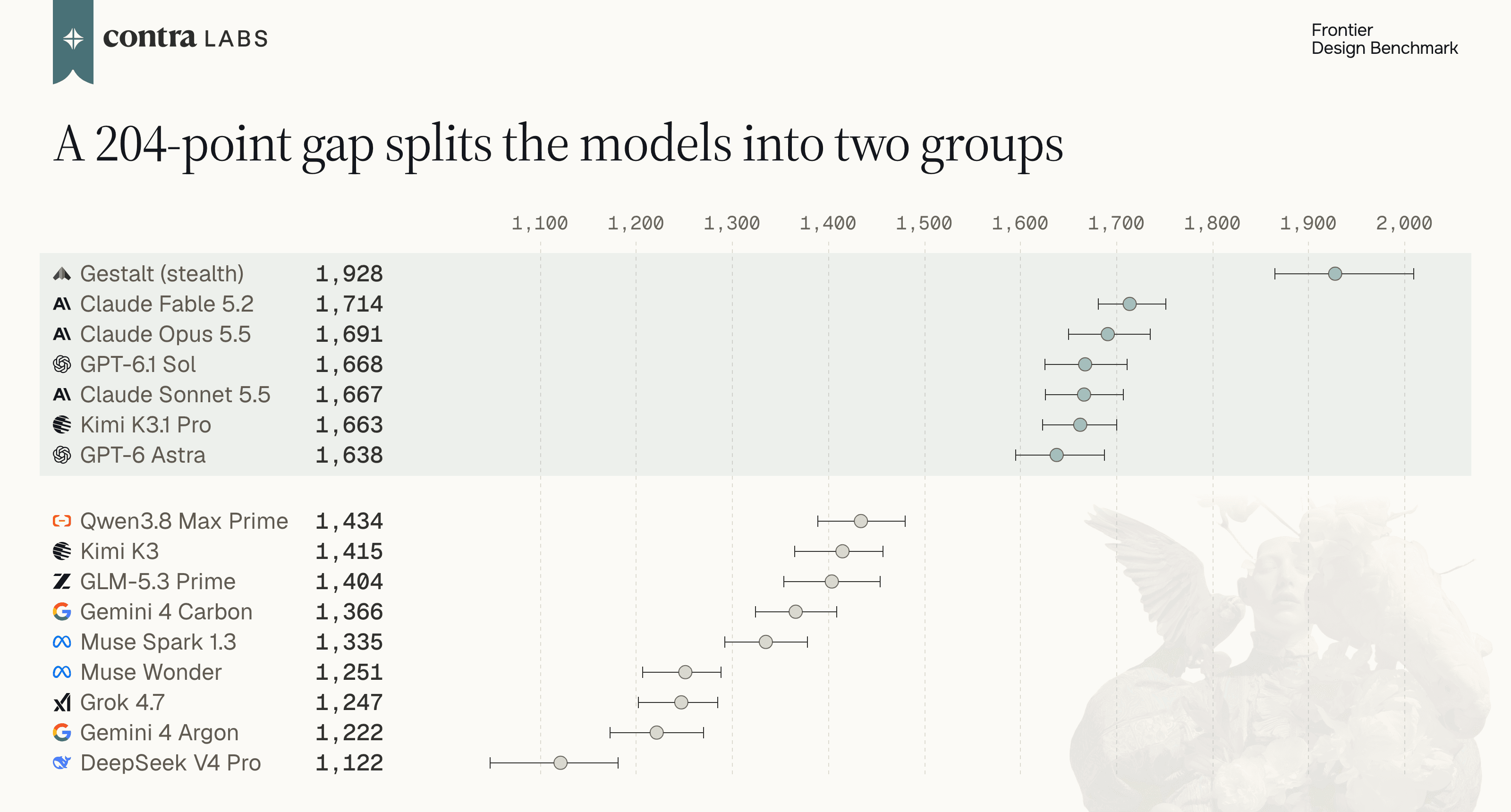 Image credit: Contra Labs original post
- Gestalt (stealth) at 1,928 Elo, winning 89% of its votes (378 of 423). It is the only entry rated above the human golden designs; when designers saw a Gestalt site next to a golden design, they picked Gestalt 20 times out of 28.
- Human golden designs at 1,739 Elo, a 74% win rate (425 of 574), ranked second.
- Claude Fable 5.2 is the highest-rated model actually run, at 1,714 Elo with a 73% win rate. It sits 214 points behind Gestalt, and the two models’ 95% intervals don’t overlap.
- The models split into two clear tiers. Six models sit between 1,638 and 1,714 Elo (three Claude models, two GPT models, and Kimi K3.1 Pro), winning 66% to 73% of their votes; the other nine sit between 1,122 and 1,434, winning 12% to 41%. The gap between the tiers is 204 Elo points — more than twice the spread inside the top group. DeepSeek V4 Pro is last at 1,122.
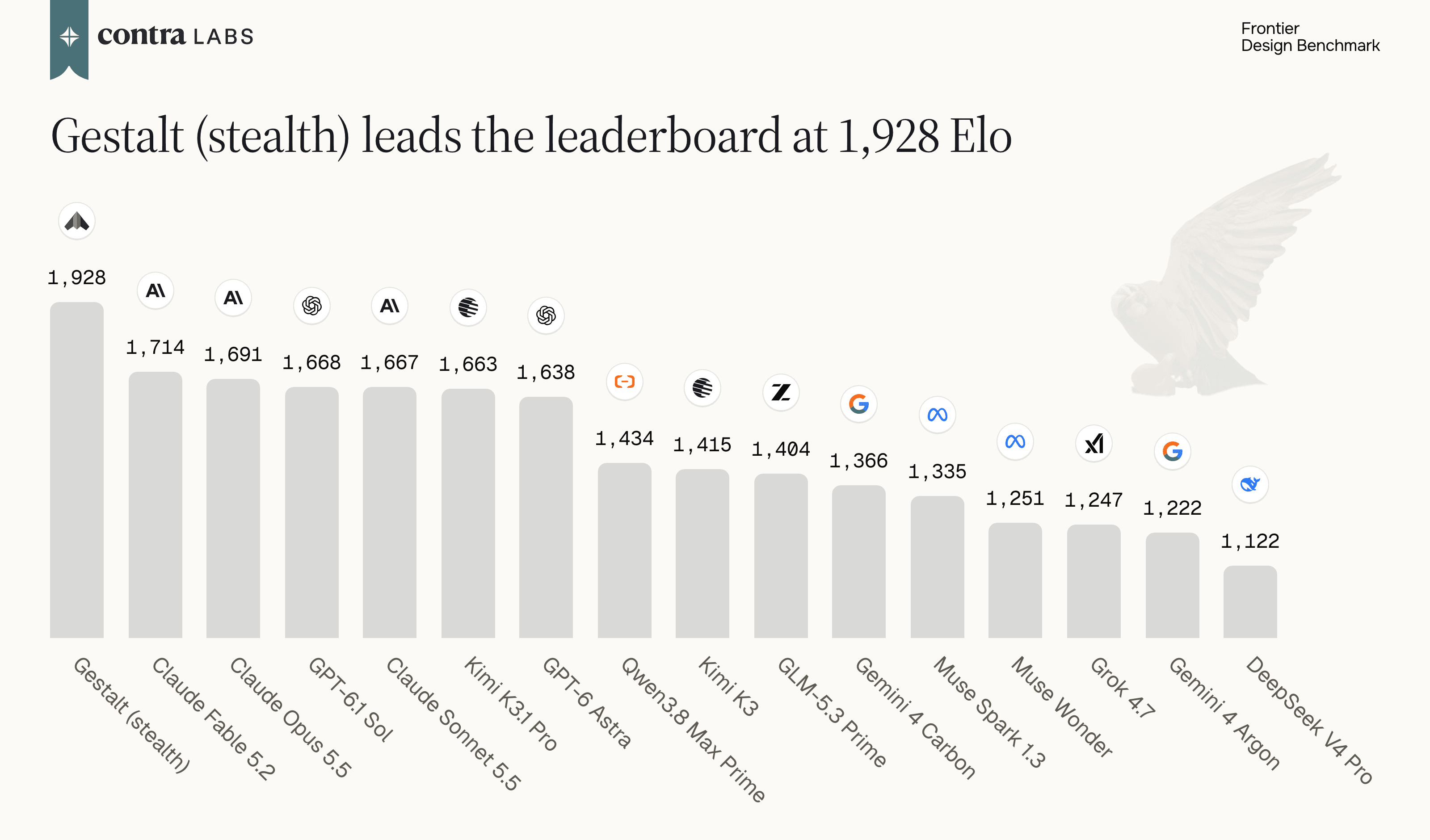 Image credit: Contra Labs original post
The rubric and the votes disagree in an interesting way: human golden designs score 73.6 on the 34-dimension rubric, sixth of 16 entries, behind the two GPT models (78.7 and 79.4) and the three Claude models (79.3 to 83.8). The golden designs lose points on execution mistakes a designer can point to — a button label too dark to read against its background, a wordmark cut off by the section above it. But designers saw the golden designs with those mistakes and still chose them in 74% of votes. The rubric counts the kind of mistakes all designers should avoid; it doesn’t measure “taste,” which is what the designers were voting on.
The Slop Detector tells a tiered story too: human golden designs read 0.9, models from 1.2 to 66. The reading follows the lab more than the ranking — the three Claude models read 31 to 38, the two GPT models 41 to 53, the two Gemini models 54 to 57. DeepSeek V4 Pro has the lowest model reading, but it is also the lowest-ranked model, and its pages are often unfinished. Gestalt, per Contra, is “significantly less AI-looking, almost on par with human golden designs” — arguably the most notable signal in the whole release: it wins not only on preference, but on not looking AI-made.
The most useful part: a checklist of AI design tells
The most portable output of this benchmark isn’t the leaderboard — it’s Contra’s list of AI slop patterns: habits designers call out as AI-looking, showing up far more often on model pages than on human ones:
- A small label above every heading. A short line of small, spaced-out capitals that repeats what the heading already says. In the Slop Detector’s training set, 93% of AI pages do this on at least half of their sections, against 11% of human pages. In this benchmark, Gemini 4 Argon does it on 92% of its pages and GPT-6.1 Sol on 89%.
- An italic word in the headline. Kimi K3.1 Pro does this on 51% of its pages and GPT-6.1 Astra (ultra) on 43%. None of the human golden designs do.
- Numbered sections: 01, 02, 03. No human page in the training set does this; 17% of AI pages do, and Kimi K3.1 Pro and GPT-6.1 Astra (ultra) number their sections on 29% of their pages.
- Everything in a card. Gemini 4 Argon puts most content in bordered or filled boxes on 97% of its pages, Gemini 4 Carbon on 94%, and Muse Spark 1.3 on 86%.
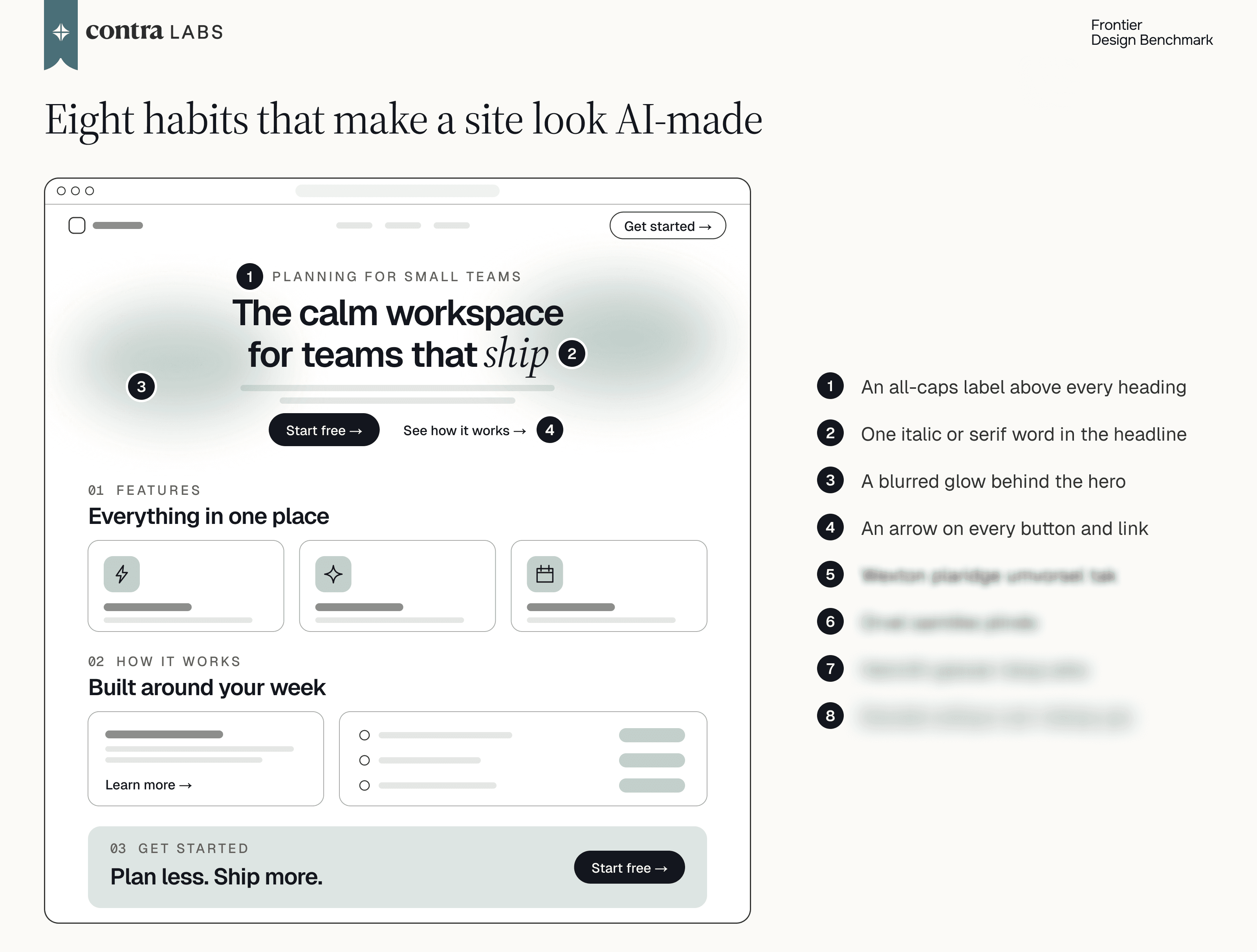 Image credit: Contra Labs original post
There is also a list of “model quirks” that nearly identifies the lab from the page: Claude models put a horizontal arrow (→) on links and buttons — Fable 5.2 on 96% of its pages, Opus 5.5 on 91%, against 46% for other labs; GPT models use a diagonal arrow (↗) — Astra on 94% of its pages and Sol on 87%, against 12% elsewhere. On 55% of GPT-6.1 Sol’s pages, most headings are slogans of two or three short parallel phrases, such as “Less paperwork. More possibility,” and its body copy stops at the benefit without saying how the product works (68% against 11%). Gemini 4 Argon goes the other way, explaining methods, conditions, and specifications on 84% of its pages, and dressing ordinary marketing sections up as technical readouts with status labels and figure references on 91%. Kimi K3.1 Pro sets cards, phones, and stickers at an angle on 68% of its pages; on 44% of DeepSeek V4 Pro’s pages, every section heading is centered (1% across all other labs).
Caveats
A few things need stating plainly:
- Who built Gestalt, whether it can be used, and when it might ship are all unknown. Rumors point to Anthropic, OpenAI, or a secret startup called SSI, but Contra hasn’t named anyone. The benchmark is Contra’s own, and the dataset is shared only on request, so no outsider can independently check the top result.
- 20 wins out of 28 is a small sample. By Top5Apps’ arithmetic, the true rate could plausibly sit anywhere from about 53% to 85%.
- The numbers move daily. The launch post gave Gestalt 1,928 Elo; the live leaderboard later showed 1,931 Elo with a 90% win rate, human golden designs at 1,739, and Fable 5.2 at 1,713. Figures from different snapshots should not be mixed.
- The pages disagree on details. The designer count appears as both 35 and 68 in different places, and the launch posts used an earlier vote count.
Setting the mystery model aside, this benchmark’s genuinely useful outputs are two: among public models, Claude Fable 5.2 is currently the strongest you can actually call for design work; and the AI-slop checklist — before your next model-built page, put “no small-caps label above headings, no italic word in the headline, no numbered sections, not everything in a card” in the negative requirements. That may do more than switching models.
Written by

